
Bitcoin has shattered all previous records, smashing through the $100,000 psychological barrier for the first time in December 2024 and continuing its meteoric rise to over $109,000 by January 2025. This unprecedented rally, which has seen the world's largest cryptocurrency surge more than 50% since the November 2024 U.S. presidential election, represents a watershed moment for digital assets and poses critical questions for investors navigating this new financial landscape.

How the Bitcoin Rally Unfolded: From Election to Inauguration
The story of Bitcoin's historic rise is inextricably linked to the 2024 U.S. presidential election. When Donald Trump secured victory in November 2024, cryptocurrency markets immediately responded with optimism. Trump had campaigned on a pro-crypto platform, promising lighter regulation and greater institutional acceptance of digital assets. Within days of the election results, Bitcoin began its ascent from approximately $77,000 to clear $93,000 by mid-November, according to Investopedia analysis.
By December 4, 2024, Bitcoin achieved what many thought impossible just years earlier: it crossed the $100,000 threshold for the first time. Reuters reported that this milestone was "hailed even by sceptics as a coming-of-age for cryptocurrencies" as investors bet on a friendly U.S. administration to cement Bitcoin's position in mainstream finance. The rally continued through December, with Bitcoin reaching $106,000 by mid-month, as noted by BBC News.
The crescendo came on January 20, 2025, coinciding with Trump's inauguration. Bitcoin spiked to $109,036 during Asian trading hours, setting a new all-time high before pulling back slightly. CNBC reported that the inauguration-day surge reflected trader optimism about Trump's promised crypto-friendly policies, including potential executive orders to be issued in the opening hours of his second term.
Timeline: Bitcoin's Record-Breaking Ascent in 2024-2025
The road to $109,000 was paved with several key milestones that demonstrate the accelerating pace of Bitcoin's adoption and price appreciation:
- November 6, 2024: Bitcoin hits an all-time high following Trump's election victory and his promise to prioritize cryptocurrency adoption in his administration.
- November 13, 2024: Bitcoin clears $93,000 as cryptocurrency boosters anticipate a crypto-friendly economic team from the incoming administration.
- December 4, 2024: Historic $100,000 breakthrough occurs, with Bitcoin storming above this psychological barrier amid growing institutional interest.
- December 13, 2024: MicroStrategy, the corporate Bitcoin treasury leader, secures inclusion in the Nasdaq 100 index after its stock surged 573% in 2024.
- December 16, 2024: Bitcoin reaches $106,000, extending its post-election rally to over 50% gains in just six weeks.
- January 20, 2025: Bitcoin touches $109,036 during Trump's inauguration, setting a new record high before experiencing a slight reversal.
Why Bitcoin's Rally Matters: Expert Analysis and Market Impact
The significance of Bitcoin's record-breaking rally extends far beyond price charts. According to financial analysts, this represents a fundamental shift in how digital assets are perceived by both institutional and retail investors. "The link between digital assets and mainstream finance is strengthening," noted The Economist in December 2024, describing the rally as "nonsense-free"—driven by real adoption rather than speculative frenzy.
Several key factors have converged to create this perfect storm for Bitcoin:
1. Political Tailwinds: Trump's victory brought unprecedented political support for cryptocurrency. The President-elect promised to create a "strategic Bitcoin reserve" for the U.S. government, drawing parallels to the nation's gold reserves. This official endorsement from a sitting administration marks a dramatic departure from previous regulatory uncertainty.
2. Institutional Adoption Acceleration: Corporate and institutional interest has reached new heights. MicroStrategy's inclusion in the Nasdaq 100 represents a major stamp of approval from traditional finance. The company, which holds approximately 439,000 BTC worth billions, continued its buying spree in December 2024, purchasing an additional 15,350 Bitcoin at an average price of $100,386.
3. ETF Inflows and Mainstream Access: Spot Bitcoin ETFs have transformed accessibility for traditional investors. Since their introduction, these funds have accumulated over 1.1 million BTC, surpassing the estimated amount held by Bitcoin's anonymous creator Satoshi Nakamoto. According to Hashdex analysis, this represents a historic milestone in Bitcoin's journey toward mainstream financial acceptance.
4. Macroeconomic Conditions: Lower interest rate expectations and concerns about traditional currency devaluation have driven investors toward alternative stores of value. Bitcoin's fixed supply of 21 million coins contrasts sharply with the unlimited money printing capabilities of central banks, making it attractive as "digital gold" in an uncertain economic environment.
Where Things Stand Now: The Current Bitcoin Landscape
As of early 2025, Bitcoin remains near its record highs, trading in a range between $100,000 and $109,000. The cryptocurrency has demonstrated remarkable resilience despite its notorious volatility, consolidating gains rather than experiencing the dramatic corrections that characterized previous bull markets.
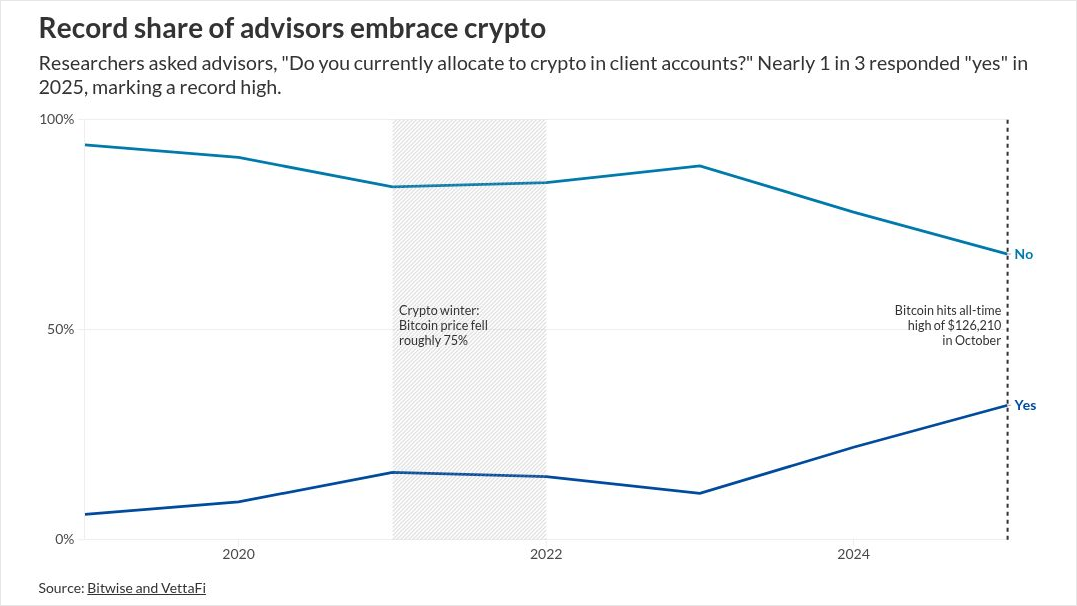
Market structure has evolved significantly. Financial advisors, once skeptical of cryptocurrency recommendations, are increasingly allocating client funds to Bitcoin and other digital assets. A January 2026 survey by Financial Planning revealed that despite recent price declines, financial advisor adoption of crypto is actually rising, with more professionals incorporating digital assets into client portfolios.
The regulatory environment continues to evolve rapidly. Trump's administration has signaled intentions to pass the GENIUS Act, legislation that would provide clearer guidelines for stablecoins and other digital assets. This regulatory clarity is expected to further reduce barriers to institutional adoption and potentially unlock trillions in traditional investment capital.
What Happens Next: The Road Ahead for Bitcoin Investors
Looking forward, analysts are divided on Bitcoin's short-term trajectory but generally optimistic about its long-term prospects. Several key developments will likely shape Bitcoin's path in 2025 and beyond:
1. Institutional Integration: As more traditional financial institutions develop Bitcoin products and services, institutional capital flows are expected to increase substantially. Bank of America's Merrill Lynch division recently announced that its advisers would be allowed to recommend Bitcoin ETFs for 1-4% of client portfolios, representing a significant breakthrough in mainstream financial acceptance.
2. Regulatory Developments: The implementation of Trump's promised crypto policies will be closely watched. The proposed strategic Bitcoin reserve could create substantial government demand, while lighter regulations might encourage innovation and investment in the cryptocurrency ecosystem.
3. Technological Advancements: Bitcoin's underlying technology continues to evolve, with improvements to scalability, privacy, and functionality potentially broadening its use cases beyond mere store of value.
4. Macroeconomic Factors: Global economic conditions, including inflation rates, currency dynamics, and geopolitical tensions, will continue to influence Bitcoin's appeal as an alternative asset class.
The Bottom Line: Key Investment Takeaways
Bitcoin's journey to $109,000 represents more than just price appreciation—it signals a fundamental transformation in global finance. For investors considering cryptocurrency exposure, several critical points emerge from this historic rally:
- Political winds have shifted decisively in favor of cryptocurrency, reducing regulatory uncertainty that previously hampered institutional adoption.
- Institutional acceptance is accelerating, with traditional finance increasingly integrating Bitcoin through ETFs, index inclusions, and advisory services.
- Portfolio allocation matters—most financial advisors recommend limiting crypto exposure to 1-5% of total portfolios due to volatility concerns.
- Dollar-cost averaging remains a prudent strategy for entering or increasing Bitcoin positions, given ongoing price fluctuations.
- Education is essential—understanding Bitcoin's technology, use cases, and risk profile should precede any investment decision.
As Bitcoin continues its evolution from speculative digital token to recognized financial asset, investors face both unprecedented opportunities and familiar risks. The record-breaking rally of 2024-2025 has demonstrated Bitcoin's growing maturity while reminding markets of its inherent volatility. For those positioned wisely, with proper research and risk management, Bitcoin may offer compelling diversification benefits in an increasingly digital financial world.