
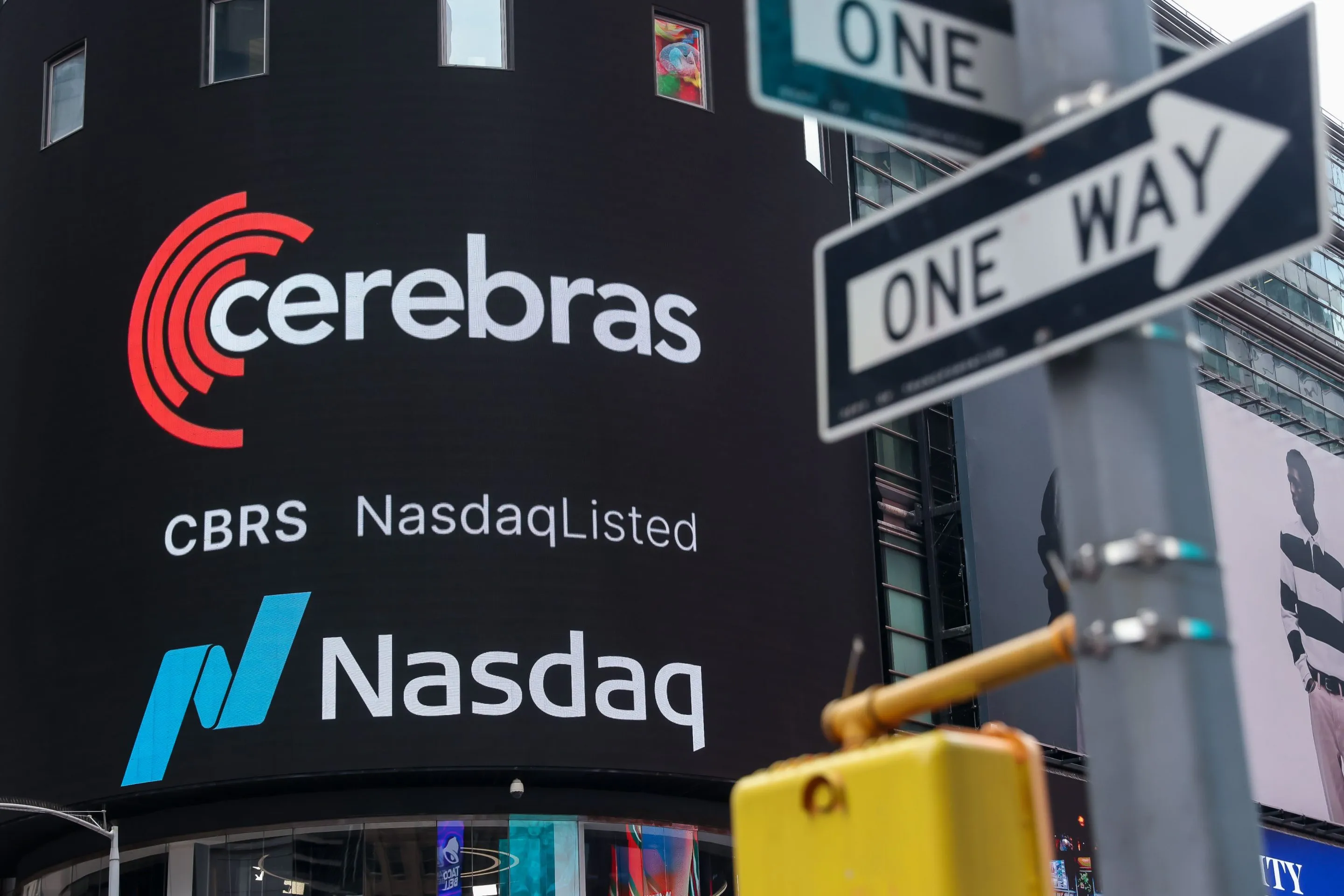
Cerebras Systems (NASDAQ: CBRS) delivered one of the most anticipated stock market debuts of the year on Thursday, with shares soaring 68% in their first day of trading on the Nasdaq. The AI chipmaker's initial public offering raised $5.55 billion, making it the largest US IPO of 2026 so far, and signaled that investor appetite for AI-related stocks remains red-hot despite market uncertainty.
The stock, priced at $185 per share, opened at $350 and surged as high as $385 before closing at $311.07. At that closing price, Cerebras commanded a standard market capitalization of approximately $67 billion, though fully diluted valuations reached as high as $95 billion according to CNBC reports. However, the stock pulled back roughly 10% on its second trading day, closing at $279.72 as some early investors took profits.
The Blockbuster IPO That Shook Wall Street
Cerebras sold 30 million shares at $185, raising $5.55 billion in a deal that was reportedly 20x oversubscribed. The IPO priced well above the company's initially indicated range of $150 to $160 per share, reflecting extraordinary demand from institutional investors. The offering was the largest US tech IPO since Arm Holdings' $4.87 billion listing in September 2023.
The blockbuster debut created two new billionaires: CEO Andrew Feldman and co-founder Gary Lauterbach, according to CNBC. The company's strong Nasdaq reception is being viewed as a bellwether for a wave of upcoming AI-related IPOs, including potential offerings from SpaceX and other high-profile tech companies.
"AI chip demand is not speculative," Feldman said in an interview following the debut, as reported by Fortune. The CEO emphasized that Cerebras is seeing real, committed spending from enterprise customers who need AI inference capabilities that the company's unique architecture can provide.
Timeline: How Cerebras Went Public
Cerebras' path to the public markets accelerated rapidly as AI infrastructure spending surged. Here are the key milestones:
- April 17, 2026 - Cerebras files its S-1 registration statement with the SEC, revealing $510 million in 2025 revenue and plans to list on the Nasdaq under the ticker CBRS.
- Late April 2026 - The company increases its IPO price range to $150-$160 per share, up from earlier expectations, following strong investor feedback during the roadshow.
- May 13, 2026 - Cerebras prices its IPO at $185 per share, well above the increased range, raising $5.55 billion at a $56.4 billion fully diluted valuation.
- May 14, 2026 - Shares begin trading on the Nasdaq, opening at $350 (89% above the IPO price) before closing at $311.07, a 68% first-day gain.
- May 15, 2026 - CBRS stock pulls back approximately 10% to $279.72 as the initial euphoria fades and investors assess the company's long-term prospects.
Inside Cerebras: Why This AI Chipmaker Matters
Cerebras has carved out a unique position in the AI semiconductor market with its radical wafer-scale engineering approach. Unlike traditional chipmakers that cut silicon wafers into individual processors, Cerebras uses an entire wafer to create one massive chip — the WSE-3 (Wafer-Scale Engine 3). This behemoth contains 4 trillion transistors, 900,000 AI-optimized cores, and delivers 125 petaflops of AI compute.
The company's CS-3 supercomputer, powered by the WSE-3, is purpose-built for AI inference — the process of deploying trained AI models to make predictions or generate content. This is a critical distinction from Nvidia, whose GPUs dominate both AI training and inference. The global AI inference market is expected to grow faster than the training market over the long term, potentially giving Cerebras a significant tailwind.
Cerebras customers can either purchase the CS-3 systems for on-premise deployment or access computing power through the company's cloud-based pay-as-you-go model. Key customers include OpenAI (the maker of ChatGPT), Amazon, and Meta Platforms. The company also has a reported billion-dollar compute deal with OpenAI, though the exact terms remain confidential.
Financial Deep Dive: Revenue Growth vs. Profitability Concerns
Cerebras' financial trajectory shows a company growing rapidly but still investing heavily in its future. Revenue has grown more than 20-fold in three years, from $24.6 million in 2022 to $510 million in 2025. The 76% year-over-year growth in 2025 outpaced even Nvidia's 65% growth in its most recent fiscal year, though from a much smaller base.

On a GAAP basis, Cerebras reported net income of $87.9 million in 2025, swinging from a $484.8 million net loss in 2024. However, this profitability metric included significant "other income" from a change in fair value of forward contract liabilities. On an operating basis, the company lost $145.9 million, driven by research and development spending that consumed 48% of revenue. Operating cash flow was negative $10.1 million — nearly break-even and improving rapidly.
For context, Cerebras' $67 billion market cap places it well below AI chip leader Nvidia ($5.7 trillion) and Taiwan Semiconductor Manufacturing ($2.2 trillion), but above many established semiconductor companies when considering revenue multiples. The company trades at roughly 131 times trailing revenue, reflecting the extreme growth premium investors are placing on AI chip exposure.
Where Things Stand Now: The Post-IPO Reality
After the initial pop, CBRS stock settled to $279.72, giving the company a standard market cap of approximately $60 billion. The stock's 52-week range now stands at $185 (the IPO price) to $386.34 (the intraday high). Trading volume has been heavy, with over 17 million shares changing hands on Day 2 alone, suggesting significant institutional repositioning.
Importantly, Cerebras appears poised for inclusion in both the S&P 500 and Nasdaq-100 indexes, given its market cap far exceeds the minimum thresholds. Index inclusion would provide a automatic buying pressure from mutual funds and ETFs that track these benchmarks.
The company's $24.6 billion order backlog — though primarily concentrated with a single customer — provides some revenue visibility. However, this customer concentration remains a key risk factor that investors should monitor closely. The Motley Fool noted that the backlog essentially comes from "one customer," though the company has since diversified with wins from OpenAI, Amazon, and Meta.
What's Next for Cerebras Stock
Analysts have begun issuing coverage on CBRS, with early assessments centering on the company's technology moat versus its valuation. The AI inference market, where Cerebras claims significant performance advantages over Nvidia, is projected to grow substantially faster than the overall AI chip market. If the company can execute on its product roadmap and diversify its customer base, the growth story remains compelling.
However, investors should weigh several risks: extreme customer concentration, the capital-intensive nature of semiconductor manufacturing, potential competitive responses from Nvidia and AMD, and the high revenue multiple embedded in the current stock price. Cerebras is still a small player relative to its giant competitors — Nvidia's revenue is 423 times larger than Cerebras'.
Key Takeaways for Investors
- Record IPO: Cerebras raised $5.55 billion at $185/share, the largest US IPO of 2026, with shares surging 68% on Day 1 before pulling back 10% on Day 2.
- Strong growth, not yet profitable: Revenue grew 76% to $510 million in 2025, but operating losses of $145.9 million reflect heavy R&D investment.
- Unique technology: Wafer-scale architecture gives Cerebras a potential edge in AI inference, a market expected to grow faster than AI training.
- Risks to watch: Customer concentration, competition from Nvidia/AMD, and an extreme valuation multiple of ~131x revenue.
- Catalysts ahead: Potential S&P 500 and Nasdaq-100 inclusion, growing AI infrastructure spending, and customer diversification.
As Motley Fool analyst Beth McKenna concluded: "All signs point to Cerebras Systems stock as worth considering for investment — at the very least, worth watching."