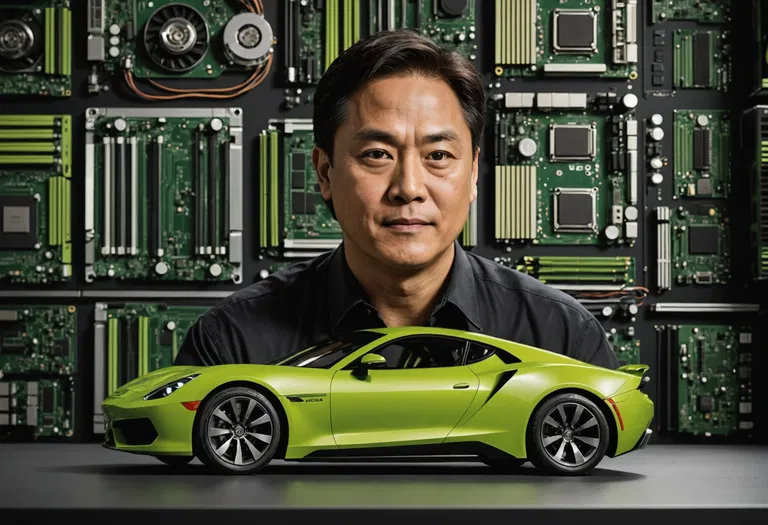
Nvidia delivered a record-shattering fiscal third-quarter earnings report on November 17, 2026 — its first since co-founder Jensen Huang resigned as chief executive — posting $115.8 billion in revenue and guiding to roughly $130 billion for the next quarter, even as its board formally slammed the door on Huang's potential return. The results crushed Wall Street estimates and arrived less than a week after Huang stepped down amid an escalating scandal involving an alleged Chinese spy, thrusting longtime chief financial officer Colette Kress into the interim CEO role and whipsawing NVDA shares. For investors, the quarter offered a powerful reminder that Nvidia's AI engine keeps roaring, even as the company navigates its most turbulent leadership crisis in three decades.
Inside Nvidia's Record $115.8 Billion Quarter
The numbers were extraordinary by nearly any measure. Revenue of $115.8 billion jumped 103% from $57 billion a year earlier and topped the roughly $109 billion analysts had expected, according to CNBC. The gain also marked a roughly 20% sequential increase. Data Center revenue — the engine of Nvidia's artificial-intelligence dominance — climbed 110% year over year to $107.6 billion. GAAP and non-GAAP gross margins came in at 74.8% and 74.9%, respectively. On the bottom line, Nvidia reported non-GAAP earnings of $2.68 per share, ahead of the $2.47 consensus estimate tracked by MarketBeat, with GAAP EPS of about $2.70.
The quarter also marked a milestone in Nvidia's product cycle: the company said it ramped production and began shipping Vera Rubin NVL72, which management described as the fastest product ramp in the company's history. That matters because Rubin is the successor to the Blackwell architecture that powered Nvidia's earlier growth, and a smooth ramp is central to the $130 billion guidance the company just issued.
Capital returns were equally aggressive. Nvidia returned a record $28 billion to shareholders during the quarter through buybacks and dividends, and in September its board approved a $150 billion increase to the share repurchase authorization — a clear signal of confidence in the company's cash generation even amid the leadership turmoil.
Timeline: From Huang's Resignation to the Earnings Call
The blowout report cannot be separated from the leadership upheaval that preceded it. Here is how the crisis unfolded in a matter of days:
- Nov. 9–10: Reports emerged that Jensen Huang had an extramarital affair with Alice Huang (no relation), a Megaspeed executive whom U.S. officials believe is a Chinese intelligence asset, as well as affairs involving multiple employees who reported to him.
- Nov. 12: Huang resigned as president, CEO, and board member. Nvidia named CFO Colette Kress as interim CEO and appointed Harvey Jones as the company's first-ever board chair.
- Nov. 16–17: Huang said he would be "honored" to return as CEO, but the board rejected the idea ahead of the report.
- Nov. 17: Nvidia reported Q3 results and issued Q4 guidance on its first earnings call without Huang at the helm.
The scandal's national-security dimension — the alleged spy was linked to a Singapore-based firm that resold Nvidia chips in southeast Asia — added geopolitical weight to what might otherwise have been a standard C-suite transition, and it cast a shadow over the company's China business just as the earnings report arrived.
Why the $130 Billion Forecast Matters for Investors
Nvidia guided fourth-quarter revenue to $130 billion, plus or minus 3%, representing roughly 12% sequential growth and including an additional 14th week in the quarter. Just as significant is what the forecast leaves out: the outlook assumes zero Data Center compute revenue from China.
That is a striking detail. China historically accounted for about 17% of Nvidia's data-center revenue — roughly $7 billion to $8 billion per quarter — before U.S. export controls tightened, and more recently about 7% of total revenue, according to Reuters. In other words, Nvidia is effectively guiding to $130 billion without China, which underscores how strong demand from U.S. hyperscalers and other regions has become.
The guidance also carries a modest margin reset. Nvidia expects non-GAAP gross margin of 71.0% to 72.0% for the fourth quarter, down from 74.9% in Q3, a shift management attributes in part to product mix as the Rubin platform ramps. Operating expenses are expected to be about $11.0 billion on a GAAP basis and $10.7 billion on a non-GAAP basis.
Analysts remain broadly constructive despite the drama. MarketBeat pegs the average analyst price target near $272.75, far above the stock's recent trading range around $156, and several analysts have argued that the post-scandal selloff of about 10% reflects excessive pessimism given Nvidia's fundamentals. Still, the risk is real: the interim CEO's comment that Nvidia would be "rigorously evaluating future investments" signals that spending discipline, not just growth, will be a focus during the transition.
Where Things Stand Now: Leadership, China, and the CEO Search
On leadership, the board's message was unambiguous. Chairman Harvey Jones opened the earnings call by stating that the board unanimously accepted Huang's resignation and does not intend to reinstate him, while vowing a fast search for a permanent CEO. Interim CEO Kress, a 13-year Nvidia veteran, sought to reassure investors as she made her debut on the company's earnings call.
On China, the exclusion of data-center compute revenue from the Q4 outlook reflects both the export-control environment and the fallout from the spy scandal. The stock itself finished the regular session at $155.46 on November 17, down 0.4% on the day, then rebounded roughly 2% to 4% in after-hours trading to above $159 as the record results and strong guidance landed. For context, the Dow Jones Industrial Average fell about 850 points that day as broader markets braced for the report.
What Happens Next for Nvidia Stock
Investors will be watching several catalysts in the weeks ahead. First, the permanent CEO search will set the tone for governance and strategy after the most turbulent stretch in the company's history. Second, Nvidia must deliver on its $130 billion quarter — the first to include the additional week — while managing the gross-margin transition tied to the Rubin ramp. Third, any further developments in U.S.–China export policy could move the stock, given that China has effectively been written to zero in the near-term outlook. Finally, with the average analyst target still far above the current share price, the stock's ability to recover its pre-scandal levels will hinge on execution rather than narrative.
The Bottom Line: Key Takeaways
- Q3 revenue of $115.8 billion rose 103% year over year and beat the roughly $109 billion estimate.
- Data Center revenue reached $107.6 billion, up 110%, with non-GAAP EPS of $2.68 beating the $2.47 consensus.
- Q4 guidance of about $130 billion excludes all China data-center compute revenue, underscoring strength elsewhere.
- The board ruled out Jensen Huang's return and vowed a fast CEO search, with CFO Colette Kress serving as interim CEO.
- Nvidia added $150 billion to its buyback authorization and returned a record $28 billion to shareholders in Q3.