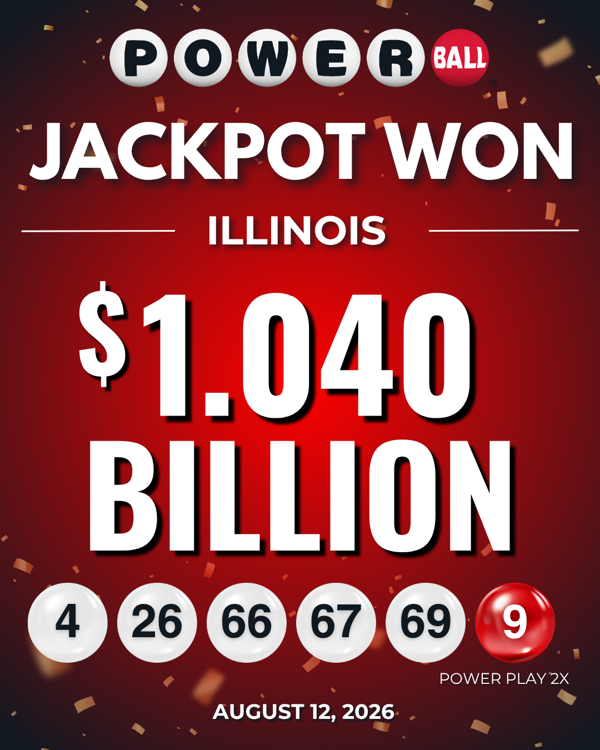
A single $2 Powerball ticket sold in Quincy, Illinois has turned an unknown player into an overnight billionaire, after matching all six numbers in the Wednesday, Aug. 12 drawing to win a $1.040 billion jackpot. The prize — the eighth-largest in Powerball history and the largest of 2026 so far — carries a cash value of $450.5 million and sets up one of the most consequential financial decisions any household can face: take the money now, or stretch it across nearly three decades.
The win ends a jackpot run that had been building since early May and caps a year in which Powerball expanded internationally for the first time. For the winner — who has not yet come forward — the harder work begins now, as financial advisers say the choices made in the next few weeks will determine whether a billion-dollar windfall becomes lasting generational wealth or a cautionary tale.
The Winning Numbers and the $500,000 Retailer
The winning ticket matched white balls 4, 26, 66, 67 and 69 plus the red Powerball 9, with a Power Play multiplier of 2. According to the Illinois Lottery, the ticket was purchased at Hy-Vee Fast & Fresh, located at 310 N. 36th St. in Quincy, Illinois — a retailer that will itself receive a $500,000 cash bonus for selling the jackpot-winning ticket.
It ranks as the second-largest lottery prize ever won in Illinois. "This is an exciting day for Illinois," said Harold Mays, Director of the Illinois Lottery. "We're thrilled for the winner and the retailer that sold the winning ticket." Mays noted that every Powerball ticket purchased during the run also helped generate funding for Illinois public schools.
Timeline: How a $20 Million Prize Grew Into a Billion
The jackpot was last won on May 2, and the run that began May 4 stretched across 44 consecutive drawings without a grand-prize winner. By late July the prize had climbed past $600 million — at the time the largest of the year — and it kept accelerating as the Aug. 12 drawing approached.
A milestone came on July 21, when Powerball ticket sales launched in the United Kingdom, making this the first jackpot run to include UK players. The expanded player base was expected to accelerate jackpot growth. Within weeks, the advertised prize crossed $856 million, then $905 million, then $975 million, before reaching $1.0 billion on Aug. 11 and finally $1.040 billion with final ticket sales.
The win is the sixth U.S. jackpot of 2026, joining a $209.3 million prize in North Carolina (Jan. 21), a $250.8 million prize in Arkansas (March 2), a $230.8 million prize in Delaware (April 6), a $143 million prize split between Indiana and Kansas (April 29), and a $20 million prize split between Florida and Texas (May 2).
The $450.5 Million Decision: Annuity vs. Cash
The winner must choose between an annuitized prize of $1.040 billion, paid in 30 graduated payments over 29 years, or a one-time lump sum of $450.5 million. Both figures are before taxes, and the gap between them — roughly $590 million — is the single largest financial lever in this decision.
Taxes reshape the headline number quickly. Lottery winnings are subject to a mandatory 24% federal withholding at payout, with the top marginal federal rate of 37% potentially applying once all income is reconciled at year-end. Illinois also levies a flat 4.95% state income tax. In practice, a lump-sum winner could see well under $300 million after combined federal and state taxes — still life-changing, but far below the billion-dollar headline.
Financial advisers who work with sudden-wealth clients generally recommend that winners take several deliberate steps before claiming: sign the back of the ticket immediately, store it securely, and assemble a small team — an experienced estate attorney, a certified public accountant, and a fee-only financial adviser — before making any irrevocable choice. The annuity option acts as a form of built-in discipline, spreading both the payout and the tax burden over decades and protecting a winner from the spending and trust mistakes that have historically undone large jackpot winners. The lump sum, by contrast, offers maximum flexibility for investment but demands stronger self-governance.
The Illinois Lottery gives the winner one year from the drawing date to claim, and officials are urging the ticket holder to sign it and keep it in a secure location until ready. That year-long window is both a deadline and an opportunity: it allows time to plan quietly before the world — and a flood of requests — arrives.
Where Things Stand Now
As of the latest update, the winner has not yet come forward. More than 3 million tickets won cash prizes in the Wednesday drawing by matching one or more numbers. Four tickets in Arizona, California, Florida and North Carolina matched all five white balls for a $1 million Match 5 prize (California's payout is pari-mutuel), and a fifth ticket in Massachusetts added the Power Play option to turn a $1 million match into $2 million.
Stephen Durrell, Chair of the Powerball Product Group and Executive Director of the Kansas Lottery, congratulated the new winner. "Powerball has shown that a winning ticket can be sold anywhere the game is played, giving every $2 ticket the chance to change not only a winner's life, but generations to come," he said.
For Saturday's drawing, the jackpot resets to $20 million, and the Power Play 10X multiplier returns since the advertised prize is below $150 million.
What Happens Next for the Winner
The path from winning ticket to billionaire is more procedural than celebratory. Once the winner signs the ticket and retains counsel, the claim will be processed through the Illinois Lottery, which has historically allowed winners to use trusts or limited liability companies to accept prizes in some circumstances — a common strategy for maintaining privacy.
Beyond the winner, the windfall already has a public footprint. Illinois Lottery players purchased more than $53.8 million in Powerball tickets during the run, generating over $21.5 million for the Common School Fund, which supports K-12 public education across the state. The Illinois Lottery, founded in 1974, has contributed more than $26 billion to that fund since 1985.
The next milestone will be the claim itself — and, after that, the annuity-or-cash election that will define whether this billion-dollar headline becomes a multigenerational portfolio.
Key Takeaways
- A single ticket sold in Quincy, Illinois won the $1.040 billion Powerball jackpot on Aug. 12, 2026 — the eighth-largest in game history and second-largest ever in Illinois.
- The winner can take a $1.040 billion annuity over 29 years or a $450.5 million lump sum, both before taxes; after federal and Illinois taxes, the take-home amount shrinks considerably.
- The ticket was bought at Hy-Vee Fast & Fresh, which earns a $500,000 bonus, and the winner has one year to claim.
- Four Match 5 tickets won $1 million each (Arizona, California, Florida, North Carolina), and a Massachusetts ticket with Power Play won $2 million.
- The jackpot resets to $20 million for Saturday, with the 10X Power Play multiplier back in play.