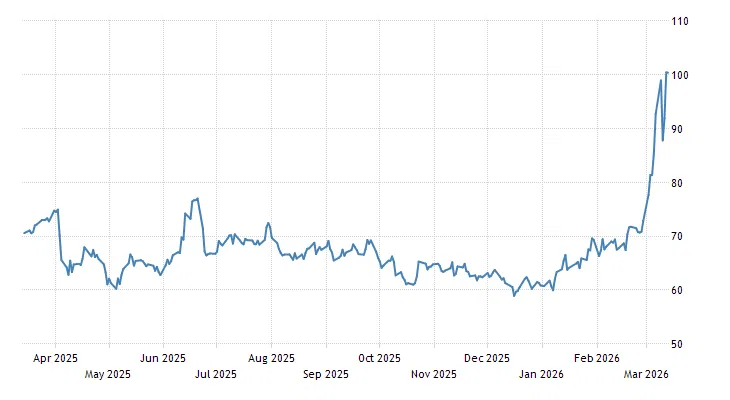
Brent crude oil prices have surged above $100 per barrel for the first time since 2022, driven by escalating geopolitical tensions in the Middle East, particularly the Iran conflict. This dramatic price movement is sending shockwaves through global financial markets, with the Dow Jones and other major indices experiencing heightened volatility as investors grapple with the implications of sustained higher energy costs. As oil prices continue to climb, understanding the interconnected dynamics between crude oil markets, stock performance, and investment strategies becomes crucial for anyone navigating today's uncertain economic landscape.
How the Iran Conflict Unfolded: Inside the Oil Price Surge
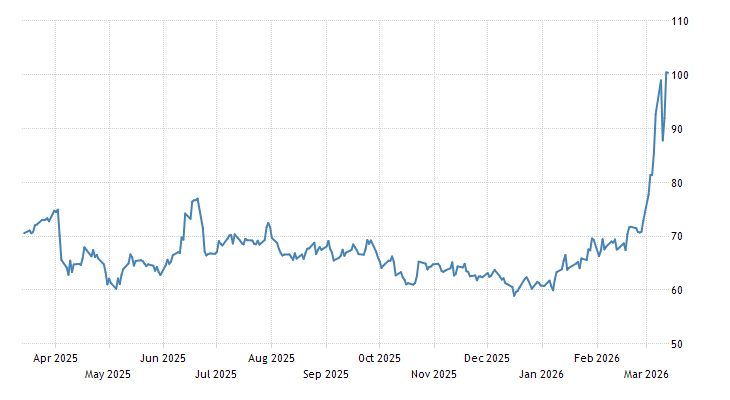
The recent spike in Brent crude oil prices is directly linked to escalating military actions in the Middle East, specifically the expanding conflict involving Iran. According to data from Trading Economics, Brent fell to 100.05 USD per barrel on March 13, 2026, down 0.41% from the previous day but representing a staggering 45.66% increase over the past month and a 41.76% year-over-year gain. This rapid appreciation marks a significant departure from the relatively stable trading range observed throughout 2024, when Brent crude oil prices traded in a narrow band according to the U.S. Energy Information Administration.

The Guardian reported that US stock markets closed on a high after the Iran war drove oil prices above $100 a barrel, highlighting the complex relationship between geopolitical events and financial market reactions. Meanwhile, Businessworld noted that markets were set for their worst week in 15 months as oil prices rose, with Brent crude futures hovering near the $100 per barrel mark amid supply concerns linked to disruptions in the Middle East.
Timeline: How Oil Prices Developed Over Recent Weeks
The road to $100 oil has been marked by several key developments. Throughout 2024, Brent crude oil prices traded in a narrow range according to EIA analysis, with benchmark futures largely unchanged in November at around $73 per barrel. The situation began shifting dramatically in early 2026 as tensions in the Middle East escalated. The conflict involving Iran triggered immediate supply concerns, pushing prices upward through February and into March. By mid-March, prices had broken through the psychological $100 barrier, creating ripple effects across global equity markets and prompting emergency meetings among energy ministers and central bankers.
Why This Oil Price Shock Matters: Expert Analysis and Market Impact
Financial experts are carefully analyzing the implications of sustained higher oil prices. Barron's examined what the Iran war really means for the stock market, noting that from inflation and interest rates to stock market reshuffling and federal deficits, this conflict could have far-reaching financial effects. Investors.com reported that the Iran war is testing investors and provided guidance on how to navigate stock market trading risks during global conflicts, recommending market exposure of 20% to 40%, down from 60%-80% right before the conflict began.
Charles Schwab's analysis of the Iran war's potential impact on global equities suggests that if tensions cool soon, the impact could be minimal. However, risks will rise significantly if global energy supplies are disrupted for an extended period. The connection between oil prices and stock market performance is particularly strong for sectors like transportation, manufacturing, and consumer discretionary, where higher energy costs directly impact profit margins and consumer spending.
Where Things Stand Now: Latest on Oil Prices and Market Reactions
As of mid-March 2026, Brent crude oil remains volatile around the $100 level, with Trading Economics forecasting an average price of $107.05 for the next quarter. Stock markets have shown mixed reactions—while some indices have recovered from initial declines, underlying volatility remains elevated. The Dow Jones Industrial Average has experienced significant swings, reflecting investor uncertainty about how sustained higher oil prices will affect corporate earnings and economic growth. Analysts are particularly watching inflation data, as energy price increases typically feed through to broader consumer prices, potentially complicating central bank policy decisions.
What Happens Next: The Road Ahead for Oil and Investments
Looking forward, energy analysts project continued upward pressure on oil prices, with Trading Economics forecasting values of $107.05, $112.12, $115.14, and $118.23 for subsequent periods. The trajectory largely depends on geopolitical developments in the Middle East and the global economic response. For investors, experts recommend several strategic adjustments: diversifying into energy-efficient sectors, considering investments in alternative energy sources, maintaining adequate cash reserves for market opportunities, and rebalancing portfolios to reduce exposure to highly oil-sensitive industries. History suggests that while geopolitical events create short-term market disruptions, long-term investment strategies based on fundamentals typically prevail.
The Bottom Line: Key Points to Remember
Brent crude oil prices above $100 per barrel represent a significant shift in global energy markets with far-reaching implications for investors. The Iran conflict has emerged as a primary catalyst for recent price movements, creating volatility across stock indices like the Dow Jones. While short-term market reactions are likely to remain turbulent, informed investors can navigate this environment by focusing on sector diversification, monitoring geopolitical developments, and maintaining a long-term perspective. As energy markets continue to evolve, staying informed about oil price dynamics and their economic consequences will be essential for successful investing in the months ahead.