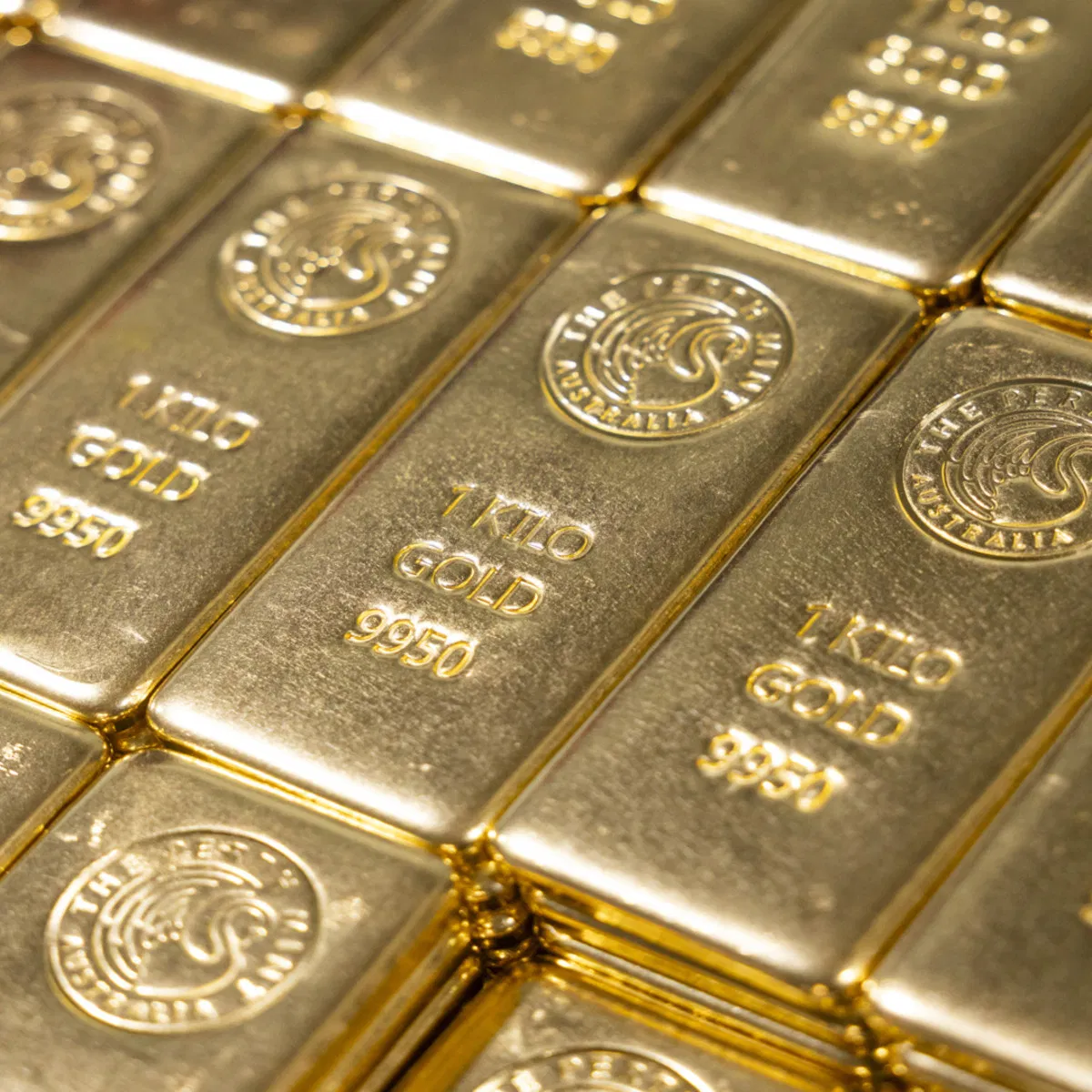
Gold prices just experienced their worst weekly drop since 1983, plummeting 9.5% as the Iran war dramatically reshapes expectations for Federal Reserve interest rate cuts. The stunning reversal comes just three months after gold hit an all-time high of $4,383.73 per ounce in December 2025, fueled by rate-cut hopes and safe-haven demand. Now, with energy prices spiking and inflation concerns returning, investors are dumping the precious metal in what analysts call a "paradoxical correction"—gold falling when geopolitical tensions should theoretically push it higher.
How Gold's Historic Run Collapsed in Just Three Months
The dramatic gold price collapse represents one of the most rapid reversals in modern financial history. In December 2025, gold was celebrating its best year since 1979, having surged 60% to reach record territory on expectations of multiple Federal Reserve rate cuts. According to Reuters, spot gold hit $4,383.73 per ounce on December 22, 2025, propelled by what analysts called "perfect conditions" for the metal—falling interest rates, dollar weakness, and strong central bank buying.
Fast forward to March 2026, and the landscape has transformed completely. The joint U.S.-Israeli strikes on Iran in early March triggered an energy price shock that has complicated the Fed's inflation fight. As Bloomberg reports, "Gold headed for its biggest weekly loss since 1983, as war in the Middle East boosted energy prices and reduced expectations for U.S. Federal Reserve rate cuts." This counterintuitive dynamic—where war-driven inflation fears push rate cuts further into the future—has undermined gold's primary investment thesis.
The numbers tell a stark story: Gold futures settled at $4,570.40 per ounce on Friday, representing a weekly loss of 9.5%—the largest single-week dollar decline on record according to Wall Street Journal data. Silver, gold's often more volatile counterpart, fared even worse, dropping over 10% at one point before recovering slightly. The precious metals complex has now given back nearly all its gains since the Iran conflict began, with gold down approximately 14% from its pre-war levels.
From Record Highs to Worst Week Since 1983: A Timeline
The rapid unraveling of gold's bull market unfolded through a series of interconnected events that reshaped market expectations within weeks:
- December 22, 2025: Gold hits all-time high of $4,383.73 per ounce as Fed signals potential rate cuts for 2026
- January 2026: Gold breaks $5,000 per ounce for the first time, extending its record-breaking rally
- Early March 2026: U.S.-Israeli strikes on Iran trigger Middle East escalation and oil price spike
- March 17, 2026: Gold holds steady as markets await Fed decision, trading around $5,200 level
- March 19, 2026: Fed indicates concern about inflation resurgence, reducing rate cut expectations
- March 20, 2026: Gold plunges 9.5% for the week, marking worst performance since 1983
This timeline reveals how quickly market sentiment can shift. As Kitco News explains, "The Iran war won't change precious metals' trajectory—a recession would." The key insight is that while geopolitical tensions typically boost gold as a safe haven, the current conflict's specific impact on energy markets has created inflationary pressures that actually hurt gold by making rate cuts less likely.
Why Gold Is Falling When It Should Be Rising
The paradoxical nature of gold's current decline centers on the complex relationship between geopolitical risk, inflation, and interest rate expectations. Traditionally, gold serves as a safe haven during times of conflict, but the Iran war has triggered a unique chain reaction that undermines this historical pattern.
"Gold is falling because the Iran conflict has boosted oil prices, which raises inflation concerns, which in turn reduces expectations for Federal Reserve rate cuts," explains a market strategist quoted by Bloomberg. Since gold pays no interest and actually has carrying costs, its appeal diminishes when interest rates remain high or are expected to stay elevated longer. The metal's opportunity cost increases as investors can earn higher returns from interest-bearing assets.
Marketplace adds crucial context: "Gold prices climbed to record highs again in December 2025, with bullion crossing $4,400 an ounce for the first time, up 60% in 2025. The rally was fueled by expectations of further U.S. Federal Reserve rate cuts after inflation showed signs of cooling." The reversal of those expectations—driven by war-induced energy inflation—has pulled the rug out from under gold's bull case.
Additional pressure comes from technical factors and investor positioning. After such an extended rally, gold had become overcrowded with speculative long positions. When the trend reversed, the unwinding of these positions accelerated the decline. Gold ETFs have seen consistent outflows since the conflict began, with BullionVault reporting that "gold and silver Comex trading has shrunk alongside ETF investment since the Iran War began, while Fed interest-rate expectations have jumped."
Where Gold Stands Now: The Current Market Reality
As of March 2026, gold finds itself at a critical juncture. The metal trades around $4,570 per ounce, having lost nearly $1,000 from its peak earlier in the month. This represents a correction of approximately 18% from the $5,594.82 record high reached in late January—technically approaching bear market territory.
Silver has experienced even more dramatic moves, having hit a historic high of $69.23 per ounce in December 2025 before retreating sharply. The gold-silver ratio—a key metric watched by precious metals investors—has widened considerably, suggesting silver may be relatively undervalued compared to gold.
Physical demand presents a mixed picture. While retail investors have shown increased interest in gold coins and bars during the price dip, central bank buying—a major support for gold in recent years—appears to have paused as institutions assess the new market dynamics. According to industry reports, some central banks are temporarily sidelined, waiting for clearer signals about the Fed's policy path and the conflict's evolution.
Market sentiment, as measured by the Kitco Gold Survey, shows Wall Street analysts deeply divided on gold's near-term direction. Approximately 40% expect further declines, 35% anticipate a rebound, and 25% see sideways consolidation. This lack of consensus reflects the extraordinary uncertainty created by simultaneous geopolitical and monetary policy crosscurrents.
The Road Ahead for Gold Prices: Expert Forecasts and Scenarios
Despite the dramatic selloff, major financial institutions maintain surprisingly optimistic long-term outlooks for gold. J.P. Morgan, in a February 2026 research note, reiterated its year-end target of $6,300 per ounce, citing sustained central bank demand, potential ETF inflows, and a structurally weaker U.S. dollar. The bank's analysts acknowledge near-term headwinds but argue that "the fundamental case for gold remains intact over a 12-18 month horizon."
GoldSilver.com elaborates on this bullish case: "The latest gold price forecasts for 2026 have Wall Street holding firm near $6,000–$6,300. Here's what the Fed decision, Iran conflict, and debt data mean for gold right now." The analysis suggests that once the initial shock of the Iran conflict passes and its inflationary impact becomes better understood, gold could resume its upward trajectory—especially if the economic consequences of the war include slower growth or recession.
Several potential scenarios could unfold:
- Bear Case: If the Iran conflict de-escalates quickly and the Fed maintains hawkish rhetoric, gold could test support around $4,200-$4,300 before stabilizing.
- Base Case: Continued volatility within a $4,500-$5,200 range through mid-2026 as markets digest conflicting signals.
- Bull Case: A recession triggered by the economic impact of the war could revive gold's safe-haven appeal, potentially driving prices toward $6,000 by year-end.
Deutsche Bank and Bank of America have similarly maintained year-end targets above $6,000, though both acknowledge these forecasts were published before the Iran conflict escalated. The key variable remains the Federal Reserve: if inflation proves stickier than expected due to persistent energy price pressures, rate cuts could be delayed further, extending gold's period of weakness.
Key Takeaways for Investors Navigating Gold's Volatility
The gold market's dramatic reversal offers crucial lessons for investors. First, understand that gold's relationship with geopolitical risk isn't straightforward—the metal responds not to conflict itself but to how that conflict affects interest rate expectations. Second, recognize that crowded trades can unwind violently, especially when the fundamental narrative shifts as rapidly as it has in recent weeks.
For those considering adding or adjusting gold allocations, several principles apply: Dollar-cost averaging into positions may be preferable to timing the market bottom. Physical gold provides portfolio insurance but carries storage costs. Gold mining stocks offer leverage to price movements but introduce additional risks. And most importantly, gold should typically represent a modest portion (5-10%) of a diversified portfolio rather than a speculative bet.
As the market digests these extraordinary developments, one thing remains clear: gold continues to play its historical role as a barometer of global uncertainty, monetary policy expectations, and economic anxiety—even if its recent movements have defied conventional wisdom. The coming months will reveal whether this correction represents a healthy pause in a longer-term bull market or a more fundamental reversal of gold's fortunes.